

The little satellites scattered behind every page on this site are amateur radio satellites (OSCARs), drawn for us by Francis Fletcher. Here they are, with a few facts about each one. All the facts come from AMSAT, the Radio Amateur Satellite Corporation, and its sister AMSAT organisations (JAMSAT, AMSAT-UK); each card links to its sources. Where we aren’t sure which satellite a drawing shows, the card says so.


OSCAR 0
The Moon
- Country / team
- Earth's natural satellite
- Launch
- Well before AMSAT's time
- End / status
- Not planned
- Orbit
- Roomy: perigee about 363,300 km, apogee about 405,500 km (mean 384,400 km), 5.1° to the ecliptic, one lap every 27.3 days
The original passive reflector: hams bounce signals off the Moon for Earth–Moon–Earth (EME, moonbounce) contacts. No transponder, no telemetry, excellent uptime.
Source: NASA Moon fact sheet (orbit)

OSCAR 1
AO-1 · the satellite in the R3 logo
- Country / team
- United States: Project OSCAR, launched with the ARRL and the US Air Force
- Launch
- 12 December 1961, with Discoverer XXXVI from Vandenberg
- End / status
- Re-entered after 22 days
- Orbit
- Low Earth orbit, about 240 × 440 km (150 × 275 miles), one lap every ~92 minutes
Amateur radio's first satellite: about 10 lb with a beacon. More than 570 hams in 28 countries sent in reception reports. AMSAT says it was also the very first satellite of any kind to be ejected as a secondary payload and enter its own orbit, pushed off by a $1.15 spring from Sears.
Sources: AMSAT history · AMSAT launch list · OSCAR newsletter, Dec 1961 (AMSAT reprint)

OSCAR II
- Country / team
- United States: Project OSCAR
- Launch
- 2 June 1962
- Orbit
- AMSAT's records give no figures
A follow-up to OSCAR I with better temperature sensing, a cooler surface coating and a lower-power beacon.
Source: AMSAT history
OSCAR III
- Country / team
- United States: Project OSCAR
- Launch
- 9 March 1965
- End / status
- Transponder worked for 18 days
- Orbit
- AMSAT's records give no figures
The first amateur radio satellite to carry a transponder: 146 MHz up, 144 MHz down, 1 W. About 1,000 hams in 22 countries used it.
Source: AMSAT history
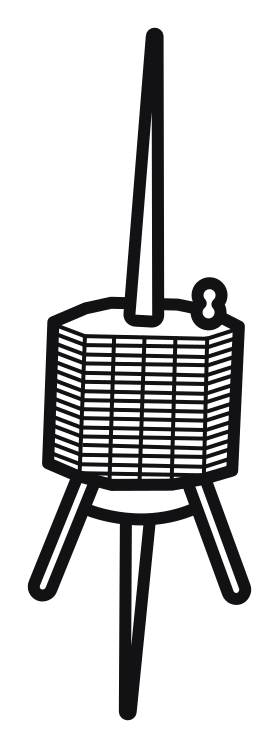
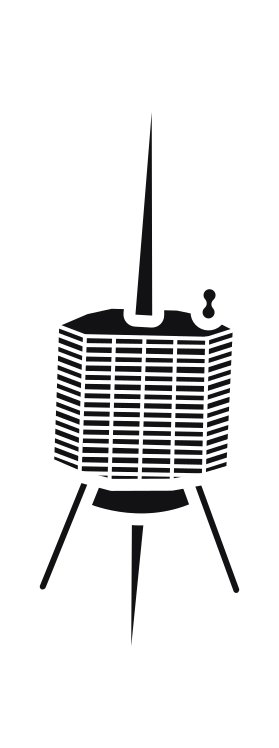
AO-7
AMSAT-OSCAR 7
- Country / team
- International: German, Canadian, US and Australian hams, led by AMSAT-NA
- Launch
- 15 November 1974, Delta 2310 from Vandenberg, with NOAA-4 and INTASAT
- End / status
- Battery failed in mid-1981; came back in 2002 and still works in sunlight
- Orbit
- 1444 × 1459 km, 101.7° inclination
An octahedral spacecraft, 360 × 424 mm and 28.6 kg, with Mode A and Mode B linear transponders and a store-and-forward unit (Codestore) for Morse and teletype messages. Built for a three-year life, it has far outlived it.
Sources: AMSAT: AO-7 · Live linear satellites

AO-13
Phase 3-C
- Country / team
- International AMSAT project; final integration in Germany
- Launch
- 15 June 1988, Ariane 4 flight V-22
- End / status
- Telemetry stopped 24 November 1996; re-entered 5 December 1996
- Orbit
- Highly elliptical: perigee about 2,500 km, apogee about 40,000 km, 58°
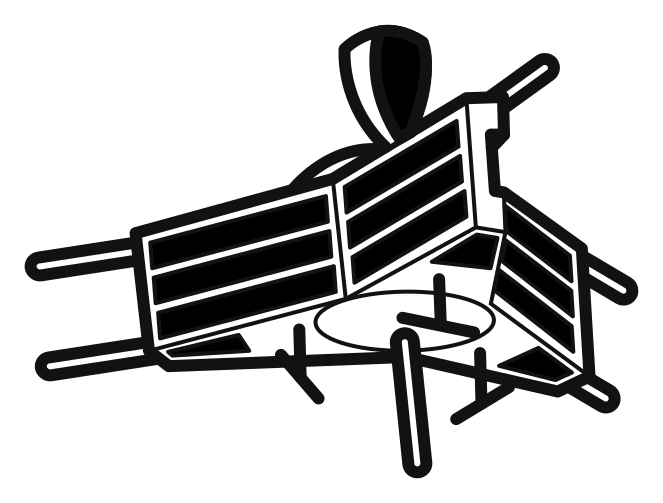
An 85 kg spinning tri-lobed spacecraft with transponders on 2 m, 70 cm, 23 cm and 13 cm.
Which satellite is this drawing? The drawing matches AMSAT's "tri-lobed" Phase 3 description; AO-10 (Phase 3-B, launched 16 June 1983 from Kourou) shared the design.
Sources: AMSAT (G3RUH) 122 · AMSAT (G3RUH) 114 · AMSAT (G3RUH) 118 · Getting Started (AO-10) · AMSAT history
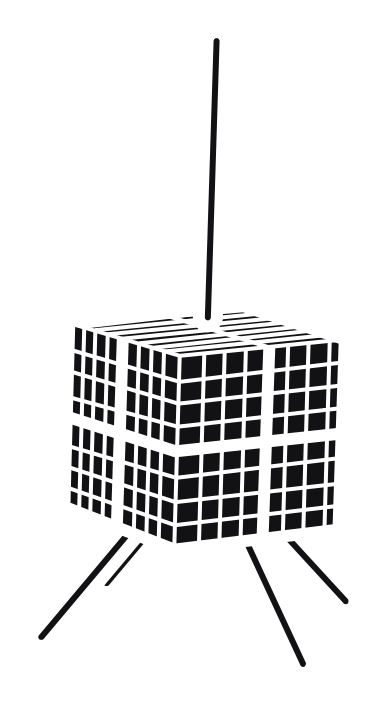
UO-11
UoSAT-2
- Country / team
- United Kingdom: University of Surrey, England (UO = UoSAT-OSCAR)
- Launch
- 1 March 1984, Thor-Delta from Vandenberg
- End / status
- Only the 145.825 MHz beacon still works; no battery since 2008
- Orbit
- About 655 × 675 km, 97.8°, ~98 minutes (1993); slowly sinking, about 615 × 625 km by 2020
Built and launched within six months. AMSAT's UO-11 page calls it "the first satellite to carry a store and forward messaging system", with no amateur-only qualifier, though AMSAT's AO-7 page describes a store-and-forward unit on AO-7 ten years earlier. Today its beacon runs for about 10.35 days, then rests for about 10.35 days.
Which satellite is this drawing? Our best match for this drawing.
Sources: AMSAT: UO-11 · AMSAT keps 1993 (orbit) · AMSAT keps 2020
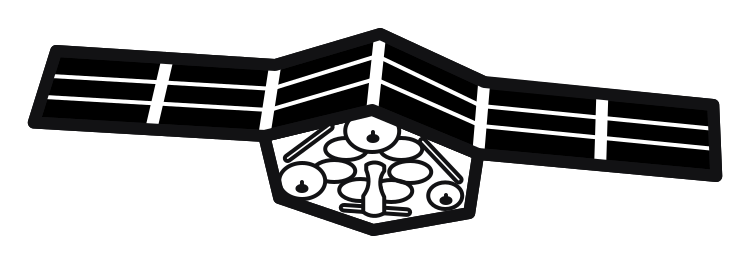
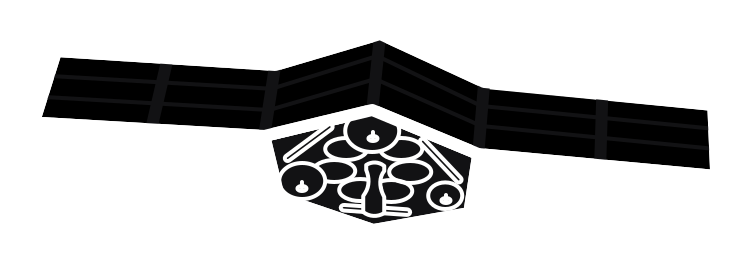
AO-40
Phase 3-D
- Country / team
- International AMSAT project, led by AMSAT-DL (Germany)
- Launch
- 16 November 2000, Ariane 5 from Kourou, French Guiana
- End / status
- Main battery failed suddenly on 25 January 2004
- Orbit
- Planned: highly elliptical, Molniya-type. Flown: about 1,200 × 58,700 km, 7.5°, one lap every ~19 hours (2002)
AMSAT planned it as the largest, most complex and most expensive amateur radio satellite ever built, covering bands from 21 MHz to 24 GHz. Its 70 cm transmitter was never heard after separation. On 13 December 2000 telemetry stopped while its 400 N kick motor was running: AMSAT experimenters believe the bi-propellant motor malfunctioned and caused a near-fatal explosion. On 25 December a reset command from New Zealand brought its S-band beacon back, and after several frantic weeks the satellite was recovered and went on to give years of useful service.
Sources: AMSAT: What is Phase 3-D? · AMSAT history · JAMSAT: AO-40 updates, Dec 2000 · ANS-321 (battery) · AMSAT keps 2002 (orbit)


FO-99
Fuji-OSCAR 99 · NEXUS
- Country / team
- Japan: Nihon University with JAMSAT
- Launch
- 18 January 2019, Epsilon from JAXA's Uchinoura Space Center, Japan
- End / status
- Re-entered 9 November 2023, after nearly five years in orbit
- Orbit
- About 475 × 510 km, 97.2°, ~94.5 minutes (2020)
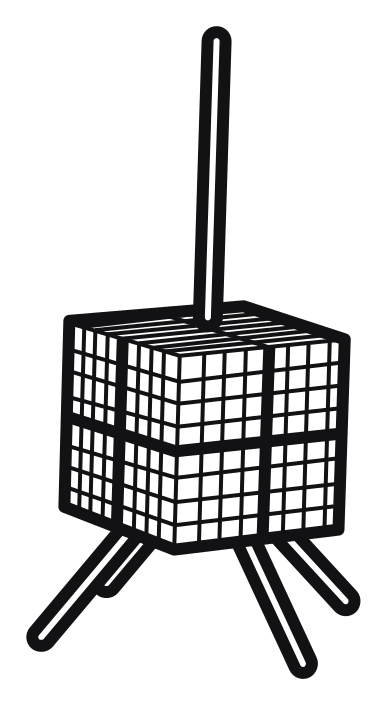
NEXUS ("NExt generation X Unique Satellite") was a 1U CubeSat of about 1.2 kg, built by Nihon University College of Science and Technology with JAMSAT. It carried a V/u linear transponder (145.900–145.930 MHz up, 435.880–435.910 MHz down, SSB/CW), a 437.075 MHz CW telemetry beacon, FSK and π/4-QPSK data downlinks, a camera and SSTV.
Which satellite is this drawing? Most likely NEXUS: the drawing is a 1U cube, as NEXUS was, but it could also be another 1U CubeSat.
Sources: AMSAT: NEXUS designated FO-99 · JAMSAT · AMSAT-UK: FO-99 · AMSAT-UK: NEXUS poster · ANS-316 (re-entry) · AMSAT keps 2020 (orbit)
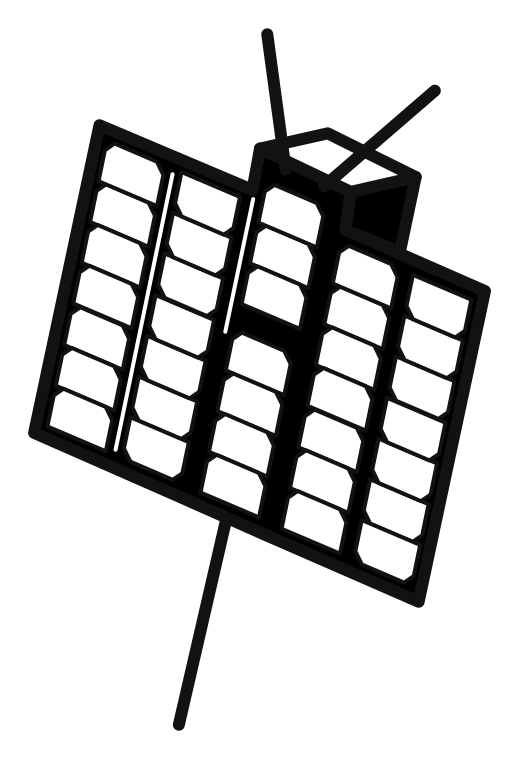
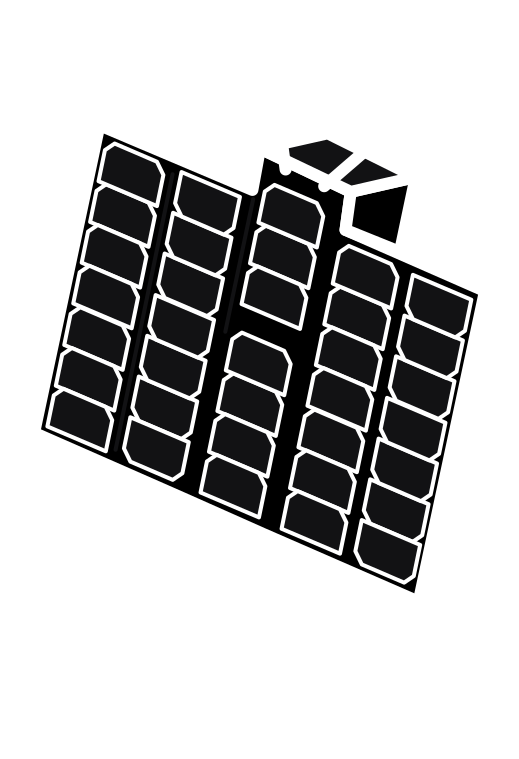
GOLF-TEE
Greater Orbit, Larger Footprint
- Country / team
- United States: AMSAT (AMSAT-NA)
- Launch
- Not launched yet: in subsystem development and flat-sat testing
- Orbit
- Planned: about 600 km, 63–98° inclination
A 3U CubeSat test bed for AMSAT's GOLF program: deployable solar panels, attitude control and a 10 GHz software-defined radio.
Sources: AMSAT: GOLF program · NASA CubeSat Launch Initiative · AMSAT project status
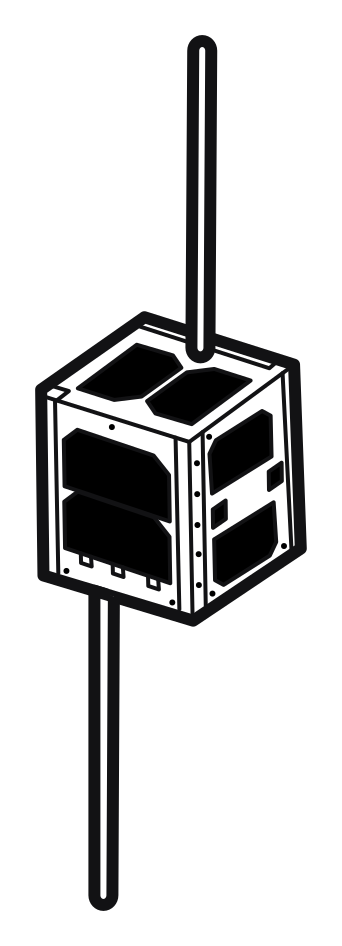
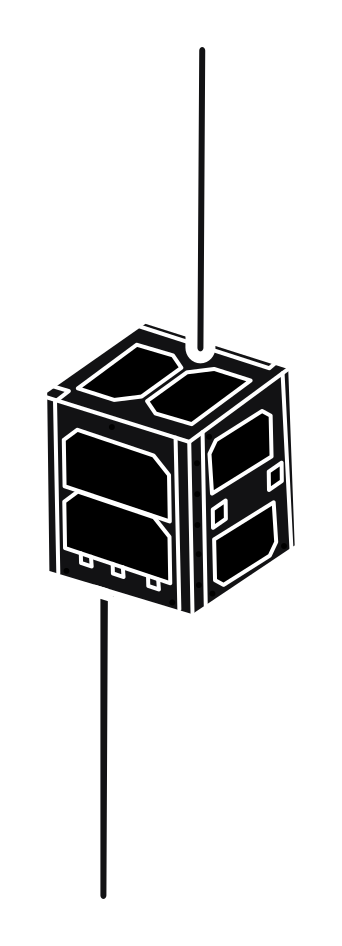

Fox-1
AO-85 · AO-91 · AO-92 · AO-95
- Country / team
- United States: AMSAT (AMSAT-NA)
- Launch
- AO-85: 8 Oct 2015 (Atlas V) · AO-91: 18 Nov 2017 (Delta II) · AO-92: 12 Jan 2018 (PSLV) · AO-95: 3 Dec 2018 (Falcon 9)
- End / status
- AO-85 ended Feb 2020 · AO-91 works in sunlight only · AO-92 re-entered about 3 Feb 2024 · AO-95 never commissioned
- Orbit
- AO-85: 518 × 810 km, about 65°
AMSAT's 1U CubeSats (10 cm, about 1.33 kg), each carrying a U/V FM repeater that a handheld radio can work.
Source: AMSAT: Meet the Fox project